
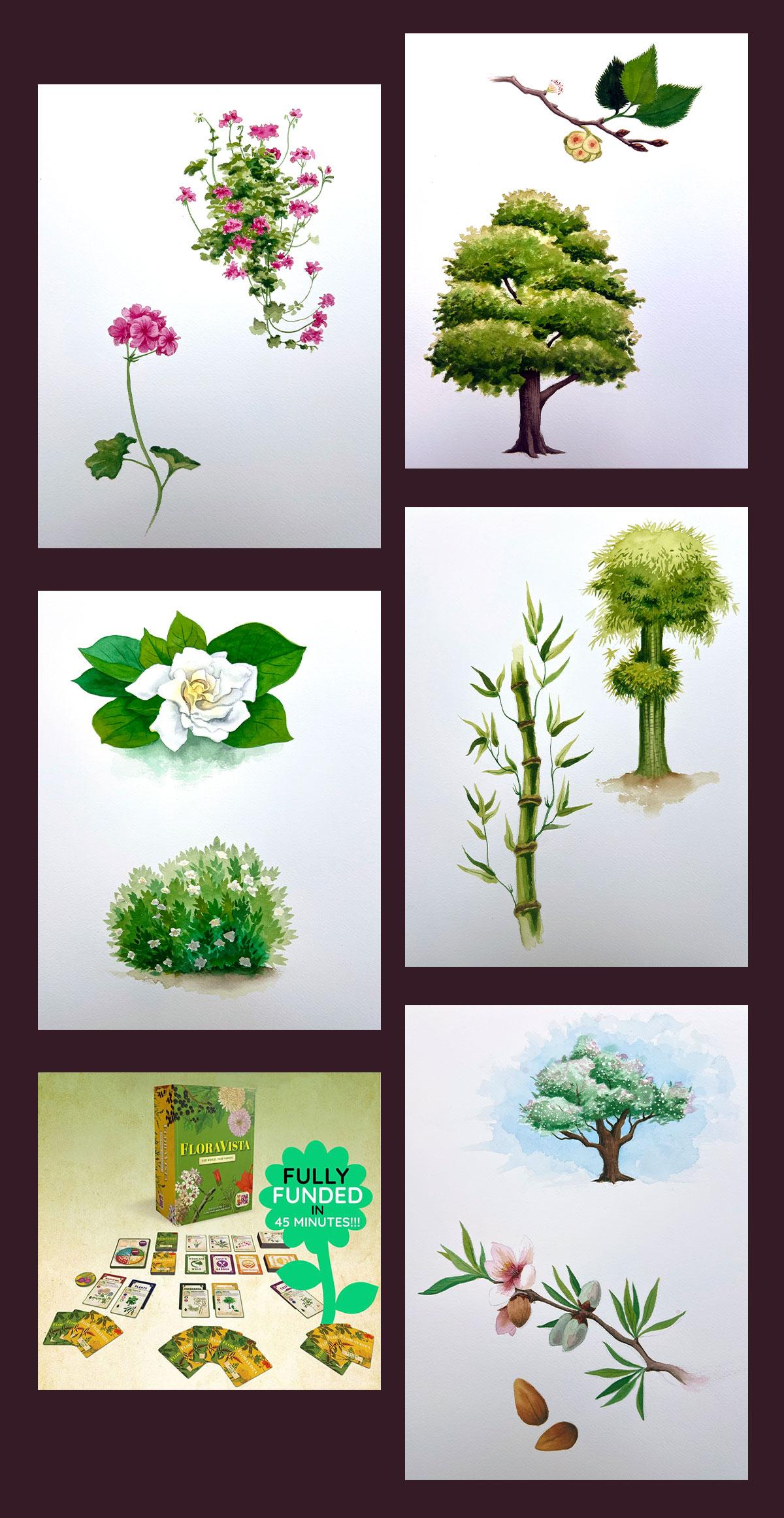
There is something genuinely meditative about this project. Batch after batch, plant after plant, each new illustration asks for complete attention, the careful observation of a leaf’s edge, the exact value of a shadow falling across a petal, the way a stem catches the light. It’s slow, patient, and deeply satisfying work. And in an age when digital tools dominate illustration, it’s worth saying plainly: every one of these paintings is traditional watercolor on paper. Real pigment, real water, real brushes. No digital shortcuts, no software assist. Just paint.
That commitment to traditional media isn’t just a technique choice. It’s entirely in keeping with the spirit of FloraVista itself.
About FloraVista
FloraVista is a cozy, strategy-driven card game created by Far Out Fox, in which players curate their own botanical garden using 120 beautifully illustrated plants from around the world. The game launched on Kickstarter on June 2, 2026, hit its $10,000 funding goal in 45 minutes, and ultimately raised over $41,000 from 476 backers. The response was extraordinary, a testament to how much people love beautiful botanical art and thoughtful game design.
The Kickstarter campaign is still running and accepting late pledges, so if you haven’t backed FloraVista yet, there’s still time to get in. Don’t miss it.
The Approach
Every illustration in the FloraVista series follows the same structure: a full rendering of the plant paired with smaller detail insets that highlight something botanically interesting or visually distinctive about that particular species. The goal is to give each card both visual presence and genuine educational value, something a player will want to study, not just glance at. All of it painted by hand, in watercolor, one careful layer at a time.
Here’s a look at the five plants in Batch Three:
Almond Tree (Prunus dulcis) — The almond tree is one of the most ancient cultivated plants on earth, and there’s something fitting about rendering it in the most ancient of painting traditions. The illustration captures the tree in its glorious early-bloom state, clusters of delicate pale pink blossoms breaking open against bare branches, alongside a detail inset showing the almond fruit, its velvety outer hull split open to reveal the familiar shell within. The soft washes of watercolor are a perfect match for the hazy, dreamlike quality of an almond orchard in full flower.
Gardenia (Gardenia jasminoides) — Few flowers reward close observation the way a gardenia does, and this illustration leans into that fully. The primary composition centers on those impossibly creamy, layered white blooms set against a backdrop of deep, lustrous green foliage. A study in high contrast that watercolor handles beautifully through wet-on-wet washes and precise dry-brush detail. A detail inset isolates a single bloom in cross-section, showing the spiral arrangement of petals at the heart of the flower. This was one of the most pleasurable paintings in the batch to work through.
Common Bamboo (Bambusa vulgaris) — Bamboo presents a fascinating illustration challenge: a plant that is simultaneously architectural and organic, rigid and graceful. The composition shows a cluster of towering culms reaching upward, their distinctive nodes and internodes rendered with clean, confident brushwork, while delicate fans of narrow leaves trail from each joint in layered washes of green and yellow-green. The detail inset focuses on a single node up close, celebrating the remarkable engineering of bamboo’s structure. Getting the variety of greens right — from the warm golden-green of a mature culm to the cooler, brighter green of fresh shoots — was the real watercolor puzzle here.
Ivy Geranium (Pelargonium peltatum) — This trailing beauty is a favorite of window boxes and hanging baskets across Europe, and its cascading, glossy-leaved form is a gift to illustrate. The main panel shows long, flowing stems arching outward, heavy with clusters of vivid pink blooms and the plant’s characteristic shield-shaped leaves. Watercolor’s natural tendency toward soft blooms and flowing color transitions is perfectly suited to the ivy geranium, the petals practically paint themselves. A detail inset isolates a single flower cluster and a set of leaves, showing the delicate veining and the subtle sheen on the foliage.
Wych Elm (Ulmus glabra) — The wych elm is a majestic native of the European highlands, and this illustration gives it the grandeur it deserves. The full-tree composition captures its broad, spreading canopy and the characteristic upswept arc of its major branches. What makes the wych elm botanical illustration special is its seed: the samara, a papery winged disc with the seed nestled at its center, is shown in a detail inset with a precision that makes it unmistakably botanical.
Still Painting
Three batches in after the launch (nine batches total) and the work continues to be very enjoyable. Every plant brings its own visual logic, its own palette, its own set of problems to solve with pigment and water. That’s what keeps traditional watercolor so endlessly engaging: you can’t fake it, you can’t undo it, and every painting teaches you something.
More batches ahead as FloraVista moves toward production. And again, if you haven’t backed the game yet, go do it now.


